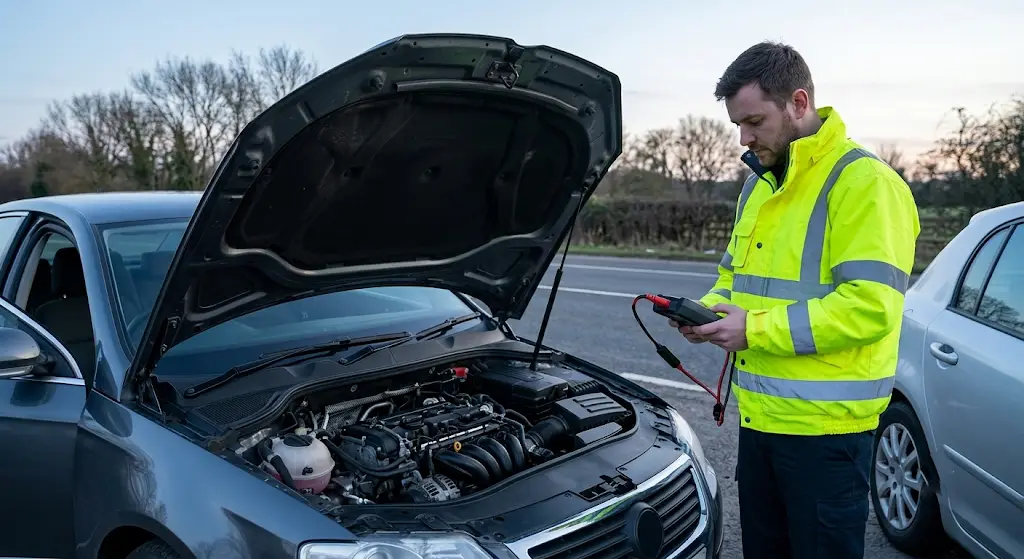
Flat batteries often ruin journeys during morning commutes. Need help starting your car safely today? Jump leads restore power between two vehicle batteries. Learning how to jump start a car correctly prevents dangerous sparks near batteries. Every driver should understand jump-starting safety procedures. Careful preparation helps protect electrical systems from damage. Incorrect cable connections can sometimes cause problems for modern vehicles.
This guide explains essential techniques. Drivers can confidently restart vehicles without roadside assistance. Always inspect batteries carefully before connecting any jump leads. Safe methods reduce stress during roadside battery emergencies. Proper positioning ensures both vehicles remain stable throughout the entire process. Following instructions carefully ensures smoother journeys after battery failures.
What Are Jump Leads?
Jump leads are thick, insulated cables that come with crocodile clips on both ends. Each end has a strong clip that grips tightly onto a battery terminal. One set of clips is red, and the other is black. Red always means positive, and black always means negative without exception.
They work by transferring electrical power from one charged battery to a flat one. Most sets sold in the UK are between three and five metres in length. A longer set of leads gives you more flexibility when parking in tight spaces. It is a wise idea to always keep a set stored safely in your car boot.
What You Need Before Starting
Make sure you have gathered all of these items before attaching anything to a vehicle.
| Item | What to Look For |
| Jump leads | Heavy-duty with firm crocodile clamps |
| Donor vehicle | A car with a fully charged battery |
| Owner’s manual | Check for any jump-start warnings |
| Safety gloves | Protect your hands from sparks |
| Flat surface | Never jump-start on a slope |
Is It Safe to Use Jump Leads on a Battery?
Jump-starting stays safe when every step is followed properly. Wrong cable connections can quickly cause dangerous sparks nearby. Battery sparks may seriously damage both people and vehicles. Always inspect the battery carefully before starting anything important.
Never jump-start cracked or leaking vehicle batteries. Turn off all electrical items before touching any jump leads. Keep both vehicles apart during the entire starting process. Always read the handbook first for hybrid or electric vehicles. Safe jump starting prevents costly damage and unwanted repair bills.
How to Jump-Start a Car with Jump Leads: Step by Step
These are the essential steps that every UK driver should know off by heart. The order in which you connect the leads is absolutely critical to getting this right. Never rush through these steps and never skip any of them for any reason at all.
Step 1: Position Both Cars Correctly
Park the working car close to the flat-battery car. Make sure both cars do not touch each other at all. You can park them side by side or facing each other on flat ground. Switch off both engines completely before you do anything else with the jump leads. This is the first stage in understanding how to jump start a car correctly.
Step 2: Locate Both Batteries
Open both bonnets carefully and take a moment to locate the batteries. You will often find the car battery at the front of the engine area. In certain cars, it may be covered with plastic trim. Check the manual if you cannot spot it.
Step 3: How to Attach Jump Leads to the Batteries
This is without doubt the most critical step of the entire jump-start process. You must connect the leads in this exact sequence every time you do this.
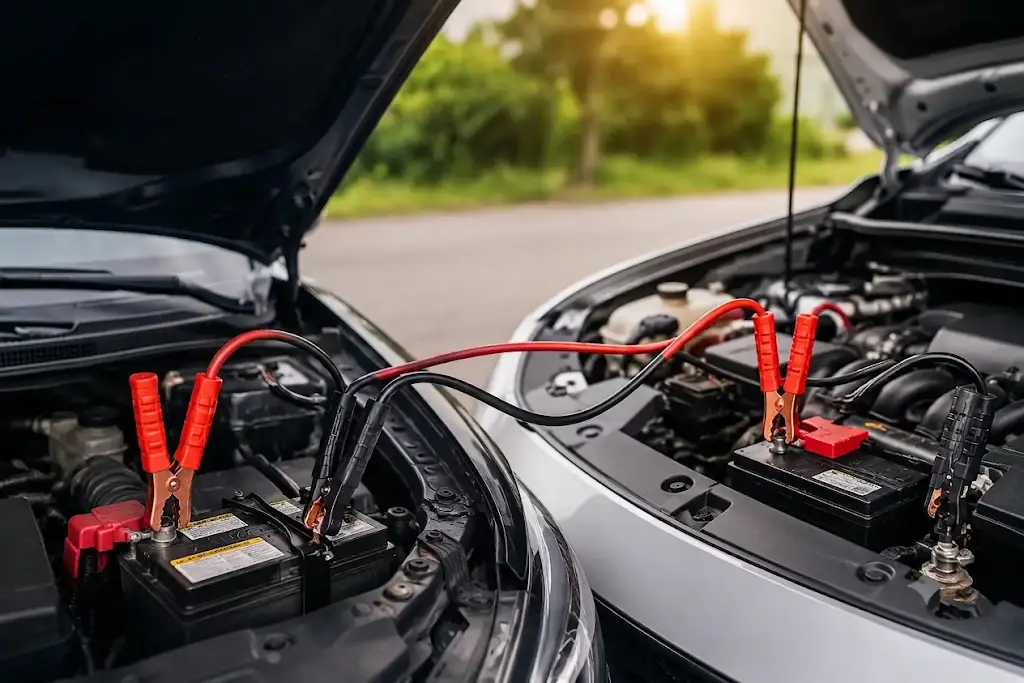
- Clip the RED lead firmly onto the positive terminal of the flat battery.
- Clip the other RED lead firmly onto the positive terminal of the donor battery.
- Clip the BLACK lead firmly onto the negative terminal of the donor battery.
- Clip the final BLACK lead onto a bare metal surface on the flat car body.
Do not connect the final black lead directly to the flat battery negative terminal. Use an unpainted metal bracket or bolt on the engine bay as your earth point instead. Following this method prevents dangerous sparks from occurring close to the battery.
Jump Lead Connection Order at a Glance
| Lead | Terminal | Which Car First? |
| Red (+) | Positive (+) | Flat battery first |
| Black (-) | Negative (-) | Donor battery first, then bare metal on flat car |
Step 4: Start the Donor Car Engine
Start the working donor car and allow it to run steadily for at least five minutes. This waiting period gives the flat battery enough time to receive a useful charge. Do not rev the engine hard or aggressively at any point during this waiting time.
Step 5: Try to Start the Flat Car
Now attempt to start the car that had the flat battery. A working engine means the jump start was done correctly. If it does not start, wait a couple of minutes and try again. Do not keep trying more than three times without stopping. Many drivers search for how to jump start a car after experiencing their first flat battery.
Step 6: Remove the Jump Leads Safely
Once the car is running, you must remove the leads in the reverse order of connection.
- Remove the BLACK lead from the bare metal earth point on the previously flat car.
- Remove the BLACK lead from the negative terminal of the donor battery.
- Remove the RED lead from the positive terminal of the donor battery.
- Remove the RED lead from the positive terminal of the now running car.
Step 7: Drive the Car for Thirty Minutes
After the car starts, drive it for at least 30 minutes. This helps the alternator recharge the battery properly. A short drive of just five minutes is not enough. Take a longer route using a main road to allow the battery to recharge fully.
How to Use Jump Leads on a Car Battery Safely
Safety has to be your number one priority every single time you use jump leads. These rules apply without exception every time you connect any jump leads.
- Stay clear of clamps: never allow bare metal clips to touch each other while connected.
- No damaged batteries: a cracked or swollen battery must never be jump-started at all.
- Clear of moving parts: always hold leads well away from belts, fans and pulleys.
- No smoking nearby: batteries release hydrogen gas close to the terminals when charging.
- Keep cars apart: the two vehicles must not make contact with each other at any point.
- Switch electrics off: turn off the radio, headlights and heater before you start.
Can You Jump Start an Automatic Car?
Yes, you can absolutely jump-start an automatic car using jump leads without any issue. The process for an automatic car is the same as it is for a manual one. Connect all leads in the same order and follow every safety rule as normal. Remove the leads in the correct reverse sequence just as you would any other car.
Some automatic cars have additional warnings printed in the owner’s manual about electronics. It is always worth checking the manual before you begin,
just to be completely sure. Certain car manufacturers now recommend using a portable battery pack as a safer option. A good quality battery pack works just as effectively as traditional jump leads in most cases.
How Do You Use Jump Leads the Right Way?
This is one of the most common questions that UK drivers ask after their first breakdown. The straightforward answer is to always follow the colour coding printed on the cables. Red goes to positive and black goes to earth, and that rule never changes at all. Never try to guess which terminal is which or mix up the red and black leads.
A single mistake at this stage can cause serious and costly damage to your electronics. Most modern cars are fitted with very sensitive electronic systems that react to power surges. Take your time and double-check every single clamp connection before you start either engine. Moving quickly is never worth the risk of causing hundreds of pounds worth of damage.
Common Mistakes When Using Jump Leads
Stress and rushing often lead to avoidable mistakes. These are the errors that catch even experienced and confident drivers completely off guard.
| Mistake | What to Do Instead |
| Wrong connection order | Always connect the red lead to the flat battery positive terminal first. |
| Cars touching each other | Keep vehicles at least one full metre apart |
| Not waiting long enough | Let the donor car run for five full minutes |
| Wrong removal order | Always reverse the exact connection sequence |
| Jump-starting a bad battery | Replace a cracked or bulging battery immediately |
| Black lead on the battery negative terminal | Earth the black lead to bare metal body only |
When Jump Leads Will Not Work
There are times when a jump start will simply not be enough to solve the problem. If the car shows no signs of life at all after three attempts, something else is wrong. The root cause of the issue may not actually be the battery in that situation. A faulty alternator will stop the battery from holding or receiving any charge at all. A seized engine will refuse to turn over regardless of how much charge you apply.
A battery cell that has completely died cannot hold any electrical charge whatsoever. In these situations, you need professional roadside assistance to come and help you quickly. Cars Breakdown Recovery provides a reliable 24/7 jump start and breakdown service right across the UK. Our trained technicians will arrive at your location within just 15 to 20 minutes of your call.
How to Jump Start Without a Second Car Nearby
If there is no donor car available to help, a portable jump starter pack is a great option. These compact and lightweight devices are small enough to fit inside your glovebox. A good quality pack stores enough power to start most standard petrol and diesel cars. You do not need another driver or another vehicle anywhere nearby to use one.
The connection order for a jump starter pack is exactly the same as for standard jump leads. Clip red to the positive terminal first, then clip black to a bare metal earth point as normal. Start the car and then remove the pack carefully in the full reverse order of connection. Always keep the battery inside the pack fully charged so that it works when you actually need it.
What to Do After a Jump Start
Getting your car started is only the first step after a breakdown. Once the engine is running, drive carefully to a nearby garage or battery shop. Do not turn the engine off on the way, as it may not start again. Ask the garage to test your battery with proper equipment. A battery that needed a jump-start could be weak or near the end of its life.
Most car batteries last around three to five years before they start to fail. You should also ask them to check the alternator. The alternator charges your battery while the engine runs. If it is not working properly, your battery will go flat again very quickly. Getting both the battery and alternator checked can help you avoid another breakdown and keep your car reliable.
Tips for Keeping Your Battery in Good Condition
Prevention is far better than dealing with a flat battery on a cold roadside morning. Following these simple tips will help your car battery last for as long as possible.
- Drive regularly: short trips drain batteries faster, so take longer drives when you can.
- Lights off: never leave any accessories running with the engine switched off.
- Annual test: take your car to a garage each year for a proper battery health check.
- Replace early: swap out the battery every three to five years as a sensible precaution.
- Winter care: cold temperatures drain batteries faster, so check yours before winter starts.
- Clean terminals: wipe away any white corrosion on terminals with a dry clean cloth.
Final Thoughts
Knowing how to jump start a car with jump leads is one of the most valuable skills a driver can have. Every UK driver should learn this process properly before a breakdown ever happens to them. Always connect red to positive and black to a bare metal earth point without exception. Take the jump leads off slowly and in reverse order once the car starts. Do not rush and follow each step carefully, even if you are in a hurry or it is cold.
If the car still does not start after three tries, the battery is likely dead and needs replacing. Our team is always ready to help with fast roadside support anytime you need it. We are available 24/7. Need help now? Call 07830 059973.
FAQs
How long does it take to jump-start a car?
It normally takes 10 to 15 minutes to complete everything. Give at least five minutes for power to move between batteries. Then drive the car for 30 minutes after starting. A short drive will not help the battery recover.
Which terminal do you connect jump leads to first?
You must always connect the red lead to the positive terminal on the flat battery first. The positive terminal is marked with a plus sign and is usually covered with a red cap. The black earth lead must always be connected very last of all in the entire sequence. Reversing this order risks causing sparks and serious damage to both cars’ electronics.
Can jump leads damage my car’s electronics?
It can cause problems if the jump leads are connected incorrectly or to the wrong points. Using the right order every time helps prevent electrical damage.
Can you use jump leads on a car in the rain?
Light drizzle should not cause any major safety issues during the jump-start process. However, you should always try to avoid jump-starting a car during heavy rainfall if possible. Standing in a puddle while handling live electrical clamps is always a serious safety risk. Wet hands near battery terminals and clamps increase the risk of slipping and causing damage.
How do you know if the battery is beyond saving?
If the car shows absolutely no signs of life at all, the battery may be completely dead. A cell that has totally failed inside the battery cannot hold any charge at all. Three failed jump start attempts in a row are usually a clear sign of a dead battery. At that point you should call a professional and arrange a full battery replacement service.
Do you need to idle the car after a jump start?
You do not need to sit and idle the engine for a long period after a successful jump start. Simply drive the car out onto a main road and travel normally for around thirty minutes. Extended driving at normal speed charges the battery far more quickly than stationary idling. Aim for a continuous thirty-minute drive rather than several short stops along the way.